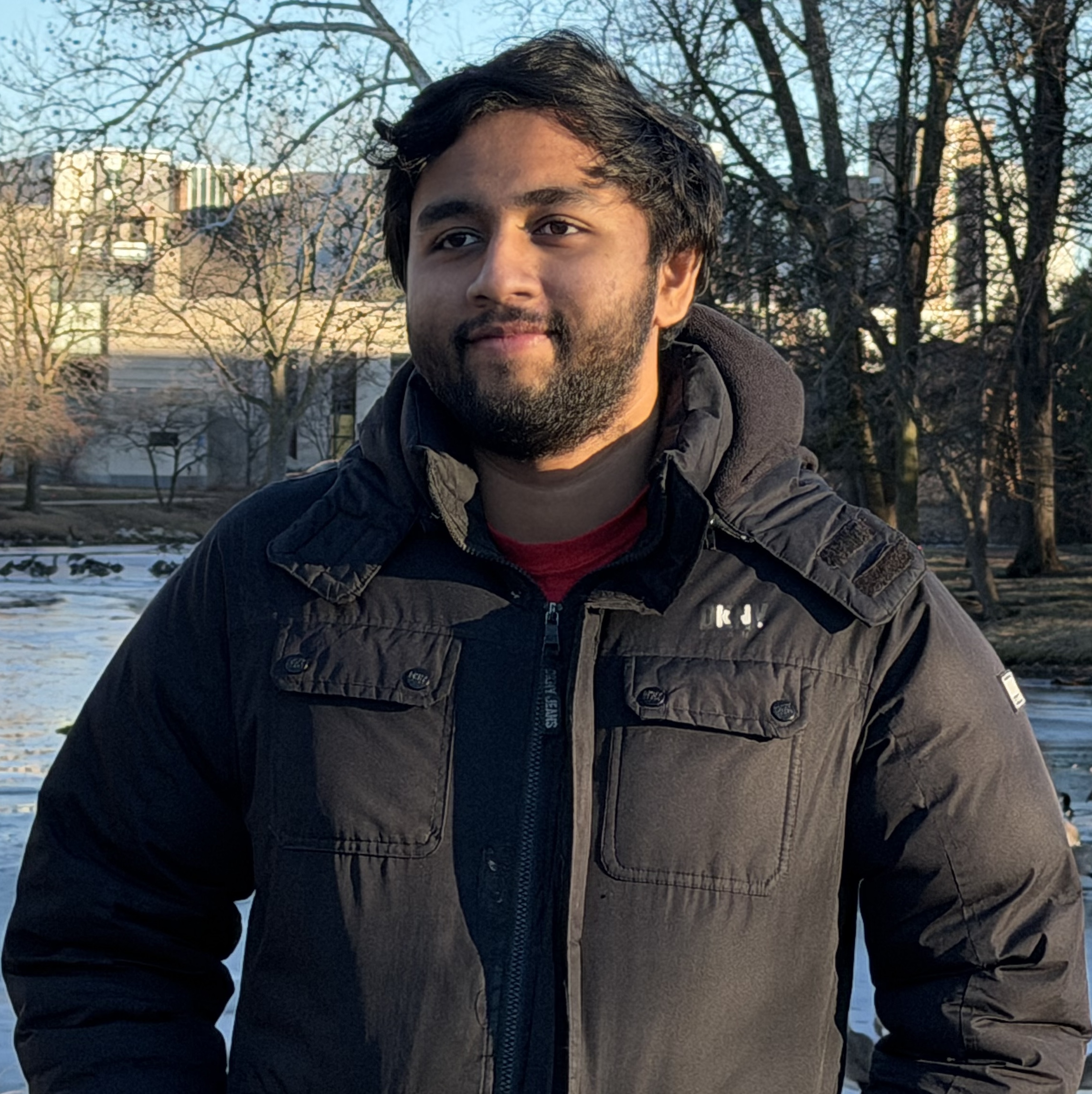
Tirtho Roy
Software & Machine-Learning Engineer · AI Researcher
Translational AI Center (TrAC)
Iowa State University
Email: tirtho@iastate.edu
Gmail: tirthoroyapon@gmail.com
About
I’m a software and machine-learning engineer and researcher at Iowa State University, pursuing a B.S. in Data Science and an M.S. in Mechanical Engineering, and conducting research at the Translational AI Center (TrAC) with Prof. Soumik Sarkar.
My M.S. thesis builds agentic vision-language systems for cyber-agriculture; I co-first-authored SAGE, accepted at a CVPR 2026 workshop. I build end-to-end systems — from web apps and data pipelines to large-scale LLM/VLM evaluation and reproducible benchmarks — spanning agriculture, healthcare, and finance.
Three questions organise most of what I do:
- Agriculture — does it still work in a real field? A model that scores well on a curated benchmark can fail on the next season’s photographs. I build agents that diagnose crop disease by reasoning over symptoms rather than pattern-matching pixels (SAGE, CVPR-W’26, on 335 crops and ~839K images), benchmark what vision-language models can actually do on plant stress (AgEval, WACV’25), ship retrieval-grounded pesticide-label guidance that abstains rather than cite the wrong herbicide (AgAdvisor, in beta with the Iowa Soybean Association), and measure what a year of distribution drift actually costs — 43.9 macro-F1 points (COMPAS’26).
- Biology & health informatics — is the model reading the biology, or the batch? High accuracy on omics and pathology data is easy to get for the wrong reasons. I audit whether frozen pathology encoders carry real biological signal or just section identity (TabPFN probing), put three pathway-informed oncology architectures on identical folds and find most of their reported gaps vanish inside the confidence intervals (TRAPS, ICCA’26), and build multi-agent evaluation loops that cut ethical violations in medical LLM output by 89% (arXiv, ACM-BCB’25).
- Optimization & geometry — what if the constraint is the interesting part? The best structure often falls out of what you are not allowed to do. When federated clients run different frozen encoders whose coordinate systems cannot be aligned, sending only coordinate-invariant Gram matrices recovers a global geometry in a single round at orders of magnitude less communication (FedQ-Vision). When compute is the binding constraint, routing each token through an adaptive number of recursions through one shared block beats bigger models with 75% fewer parameters (bioMoR) — and read as dynamical systems, transformers start to explain their own internals (APS 2026).
Representative work is highlighted with an orange badge. Click any title for the paper. Conference tiers shown in parentheses are CORE rankings; emerging venues not yet rated by CORE are marked top-tier by reputation.
Research
I work on agentic vision-language systems, large language models and multi-agent systems, and rigorous LLM/VLM evaluation, with applications across agriculture, healthcare, and finance. Representative work is highlighted. Click any title for the paper. Conference tiers shown in parentheses are CORE rankings; emerging venues not yet rated by CORE are marked top-tier by reputation.
Under Review & In Preparation
Federated learning across clients running different frozen vision encoders, whose coordinate systems cannot be averaged or aligned. Each client sends only the Gram matrix of its class prototypes — a coordinate-invariant summary — and the server recovers a global quotient geometry in a single round, with no alignment maps and no representation training. Across six benchmarks under heterogeneous CNN and transformer encoders it gave the best accuracy of all methods, +9.4 points over no collaboration, at one to two orders of magnitude lower communication.
The first Mixture-of-Recursions framework for gene- and pathway-level omics learning: biological structure drives embedding smoothing, a structural attention bias, and a graph-aware router that sets each token’s recursion depth. Across eight single-cell and multi-omics benchmarks under one five-fold protocol it improved macro-F1 by 8.2 points over the strongest biology-agnostic MoR baseline while using 75% fewer parameters and up to 58% fewer FLOPs than a non-recursive Transformer.
A training-free framework that audits whether frozen pathology foundation models encode biologically meaningful signal, pairing histology with spatial transcriptomics (HEST-1k, 240 samples across breast, skin, and brain) and using TabPFN as a standardized probe. Across five encoders, UNI led pathway decodability at 0.303, but organ-level shift cost 62% of the pathway signal and section identity stayed linearly decodable up to 214× chance — while benign augmentations retained ≥95% performance.
Conference, Journal & Workshop Papers
AgriMorph treats a field robot’s physical shape as a decision made while it works, not a fixed hardware property. Separate latent models of the terrain and of the robot’s own state let a learned world model roll out candidate futures under each available body, so shapes are compared before slip, stall or crop contact happens and changed only when the predicted gain beats the transformation cost. An ensemble-disagreement confidence gate blocks shape changes made on weak sensing, and one shape-conditioned controller carries over to every body without retraining.
A walk-forward backtesting framework benchmarks classical, neural, and world-model predictors on a global equity dataset, isolating when engineered features outperform raw price inputs across model families.
An autonomous, symptom-grounded vision-language agent for crop-disease diagnosis, built on the largest plant-disease image–symptom dataset to date (335 crops, 1,251 classes, ~839K images). Stepwise diagnostic reasoning raised accuracy by +16.2 points and generalizes to unseen crops with no retraining.
Selected for poster presentation at the AI Scientist Summer Workshop hosted by Microsoft Research (Aug 4, 2026): an autonomous, symptom-grounded vision-language agent for crop-disease diagnosis, evaluated on the largest plant-disease image–symptom dataset to date with stepwise diagnostic reasoning that generalizes to unseen crops.
The first unified benchmark for pathway-guided cancer therapy-response modeling (BINN, GraphPath, PATH), over 2,622 TCGA patients across 5 cohorts; the best model reached 0.92 AUROC on prostate targeted-therapy prediction at 11% class prevalence.
A cross-year benchmark for rice-disease recognition on Bangladeshi field images: training on 2021–2025 and testing only on held-out 2026 data cost 43.91 macro-F1 points across all eight model/strategy configurations, with only 48.28% of validation performance retained. The better fine-tuning strategy proved architecture-dependent, and the most temporally robust model was not the one validation ranked first.
A multi-agent iterative-refinement system (generators DeepSeek R1 + Med-PaLM; evaluators LLaMA 3.1 + Phi-4) aligned to AMA ethics and a five-tier safety assessment. Cut ethical violations by 89% with a 92% risk-downgrade rate over 900 clinical queries.
A reinforcement-learning intervention engine that models intervention timing and selection as a sequential decision problem for syndemic health management.
A first-authored analysis interpreting transformer architectures through physics and dynamical-systems theory to explain their internal computation dynamics.
An agentic, pathway-grounded tree-of-thought inference pipeline that structures LLM reasoning over biological pathway knowledge for mechanistic therapeutic reasoning in oncology.
Benchmarked LLaMA on multi-class healthcare test-result prediction, assessing reliability for responsible medical-AI deployment.
Baseline benchmarks and reproducible metrics for protein structural-ensemble prediction in computational structural biology.
An LLM-powered tool to estimate and analyze carbon footprint from operational data.
A privacy-preserving federated-learning framework for multi-modal 2D/3D dental imaging with cross-modal prompt alignment, hierarchical optimization, and Byzantine-resilient aggregation with differential privacy.
The poster prototype of the multi-agent medical-LLM safety framework (DeepSeek R1 / Med-PaLM with LLaMA 3.1 / Phi-4 evaluators), later extended into the arXiv study above.
AgEval, a 12-task plant-stress phenotyping benchmark for zero-/few-shot in-context learning of VLMs (Claude, GPT, Gemini, LLaVA). Best-model F1 improved 46.24% → 73.37% (8-shot); strategic example selection added +15.38% F1.
A GPT-4o pipeline over 430 Shark Tank pitches quantifying how market orientation and brand storytelling drive investor decisions, with expert annotation and statistical validation for a peer-reviewed B2B marketing study.
Projects
Deployed Systems
Built with real-world industry partners.
- Built and deployed a multi-agent RAG assistant that answers pesticide-label questions grounded in CDMS labels, live as a public demo. Stack: FastAPI + LangGraph multi-agent orchestration, OpenAI embeddings + Qdrant vector search, GPT-4o, Streamlit/Gradio UI.
- Industry connection: developed in the Translational AI Center (AIIRA) and beta-tested with the Iowa Soybean Association, iterating directly on grower and agronomist feedback (wrong-herbicide bias, answer verbosity, mobile confidence badge, cold-start latency).
- Engineered faithful, abstaining retrieval — a product-disambiguating catalog plus abstention so the agent refuses rather than answer from the wrong herbicide label, with page-level citations: a concrete reliability guarantee for regulatory agrochemical guidance.
- Productionized with account authentication and per-user persistent history, per-user daily quotas to protect shared API keys, response caching, and a concurrency-safe shared vector store; a 62-test suite runs in CI.
Experience
- Graduate Research Assistant, Translational AI Center, Iowa State University — Jan 2025 – Present
- Undergraduate Research Assistant, Translational AI Center, Iowa State University — Apr 2024 – Present
- Undergraduate Software Developer, Dept. of Agricultural & Biosystems Engineering, Iowa State University — Jun – Dec 2024
- Undergraduate Research Volunteer, Dept. of Computer Science, Iowa State University — Apr – May 2024
Advising & Mentoring
- Taj Singh (Texas A&M University · Research Experience for Undergraduates, Translational AI Center, Iowa State University, Summer 2025)
— Peer mentor; presented at the REU Summer Symposium - Zainab Ghafoor (Sonoma State University. Current: Keysight Technologies)
— Co-authored ACM-BCB’2025 (presented the poster in Philadelphia) and TRAPS (ICCA’2026) - Sujoy Banik (Rajshahi University of Engineering & Technology, Bangladesh)
— First author on TRAPS (ICCA’2026) - Sayantan Chakraborty (University of Dhaka, Bangladesh)
— Co-first author on Leveraging Temporal Distribution Shifts for Rice Disease Detection (IEEE COMPAS’2026); co-authored TRAPS (ICCA’2026) - Md. Radoan Islam (Patuakhali Science and Technology University, Bangladesh)
— Co-first author on Leveraging Temporal Distribution Shifts for Rice Disease Detection (IEEE COMPAS’2026) - Mayank Bhatt (High school research intern, Translational AI Center, Iowa State University · Summer 2026 – Present)
— Mentoring on a FinTech project - Nilutpaul Sarker Yash (Undergraduate researcher, Iowa State University)
— First author on our WM@Booth 2026 paper; awarded the Undergraduate Conference Travel Fund to present the poster at Chicago Booth - Nikhil Bhattacharya (Department of Software Engineering, Iowa State University · Summer 2026)
— Agricultural data curation
Honors & Awards
- Selected Participant, Corteva New Frontiers Conference, Carver Center, Johnston, IA (Sep 2026) · poster: SAGE
- Finalist, Paper Competition, 2026 IEEE Nexus Region 4 Annual Student Leadership Conference (SLC), Chicago, IL (Apr 2026) · paper: Medical AI safety
- Dean’s High Impact Award for Undergraduate Research (Fall 2025)
- Best-In-Show, George Washington Carver “I Can” Poster Challenge (2025) · site · code
- Norman Borlaug Lecture Poster Competition — 1st Place, Undergraduate Division (World Food Issues) (2025) · certificate
- Bangladesh–Sweden Trust Fund Travel Grant (2025)
- College of Liberal Arts and Sciences Travel Grant, Iowa State University (2025)
- Undergraduate Conference Travel Fund, Office of the Vice President for Research, Iowa State University (2025)
- Dean’s List (Fall 2024)
In the News
| February 2026 | Discovery and curiosity come together in undergraduate research — LAS News, Iowa State University. Featured for undergraduate research at the Translational AI Center on explainable AI for persuasive digital content, mentored by Soumik Sarkar and Priyanka Jayashankar. |
| October 2025 | Award winners at the 22nd Annual Norman Borlaug Lectureship Poster Competition — Global Resource Systems, Iowa State University. Named among Iowa State students recognized at the competition, where I won first place in the undergraduate division. |
Academic Service
Professional Memberships
- Institute of Electrical and Electronics Engineers (IEEE) — Graduate Student Member, through Dec 2026 · certificate
- IEEE Computer Society — Graduate Student Member, 2026 · certificate
- IEEE Antennas and Propagation Society — Graduate Student Member, 2026 · certificate
- IEEE Young Professionals — Graduate Student Member, 2026 · certificate
- Association for Computing Machinery (ACM) — Student Member, since 2026
Program Committee
- Workshop on Secure and Trustworthy Quantum Machine Learning (SaTQuML) @ Conference on Neural Information Processing Systems 2026 (CORE A*)
- Trustworthy Agentic Systems (TAS 2026) @ Association for the Advancement of Artificial Intelligence 2026 Fall Symposium Series, Westin Arlington, Arlington, VA (Nov 5–7, 2026)
Ethics Review
- Conference on Neural Information Processing Systems 2026 (CORE A*) — Main Conference and Evaluations & Datasets Tracks
- Conference on Neural Information Processing Systems 2025 (CORE A*) — Main Conference and Datasets & Benchmarks Tracks
Conference Reviewer
- IEEE/CVF Winter Conference on Applications of Computer Vision (WACV) 2027 (CORE A · shadow reviewer, Round 1)
- 7th ACM International Conference on AI in Finance (ICAIF) 2026
- World Models @ Booth (WM@Booth) 2026, University of Chicago Booth School of Business
- Indian Conference on Computer Vision, Graphics & Image Processing (ICVGIP) 2026
- 4th International Conference on Computing Advancements (ICCA) 2026 · certificate
- 3rd International Conference on Machine Intelligence and Emerging Technologies (MIET) 2026 · certificate
Workshop Reviewer
- Workshop on AI for Verifiable Coding (VERICODEGEN) @ Conference on Neural Information Processing Systems 2026 (CORE A*)
- Medical Reasoning with Vision Language Foundation Models Workshop (Med-Reasoner) @ Conference on Neural Information Processing Systems 2026 (CORE A*)
- AI for Drug Discovery: Bridging the Translation Gap Workshop (AI4DD) @ Conference on Neural Information Processing Systems 2026 (CORE A*)
- AI for Meta-Science Workshop (AI4MetaScience) @ Conference on Neural Information Processing Systems 2026 (CORE A*)
- Diffusion Language Models Workshop (DiffuLM) @ Conference on Neural Information Processing Systems 2026 (CORE A*)
- New In ML Workshop (NewInML) @ Conference on Neural Information Processing Systems 2026 (CORE A*)
- AI for Good Workshop (AI4GOOD) @ Conference on Neural Information Processing Systems 2026 (CORE A*)
- Workshop on Collaborative, Open, and Decentralized Training of Foundation Models (CODEC-FM) @ Conference on Neural Information Processing Systems 2026 (CORE A*)
- Workshop on Dynamics at the Frontiers of Optimization, Sampling, and Games (DynaFront) @ Conference on Neural Information Processing Systems 2026 (CORE A*)
- AI for Science Workshop (AI4Science) @ Conference on Neural Information Processing Systems 2026 (CORE A*)
- Economics for Machine Learning Workshop (EconML) @ Conference on Neural Information Processing Systems 2026 (CORE A*)
- Computer Vision for Animals Workshop @ IEEE/CVF Conference on Computer Vision and Pattern Recognition 2026 (CORE A*)
- AI for Good Workshop @ International Conference on Machine Learning 2026 (CORE A*)
- AI for Critical National Infrastructure Workshop @ International Conference on Autonomous Agents and Multi-Agent Systems 2026 (CORE A*)
- Rashomon Effect Workshop @ Association for the Advancement of Artificial Intelligence 2026 (CORE A*)
- Context Beyond the Window Workshop @ Conference on Language Modeling (COLM) 2026 (top-tier)
- Social Simulation Workshop (Social Sim ’26) @ Conference on Language Modeling (COLM) 2026 (top-tier)
- LatinX in AI Workshop @ Conference on Neural Information Processing Systems 2025 (CORE A*)
- LatinX in Computer Vision Workshop @ IEEE/CVF Conference on Computer Vision and Pattern Recognition 2025 (CORE A*)
- Computer Vision for Animals Workshop @ IEEE/CVF Conference on Computer Vision and Pattern Recognition 2025 (CORE A*)
- Second Workshop on Bangla Language Processing @ International Joint Conference on Natural Language Processing and Asia-Pacific Chapter of the Association for Computational Linguistics 2025
Journal Reviewer
- Egyptian Journal of Medical Human Genetics (Springer Nature · 3 manuscripts reviewed)